
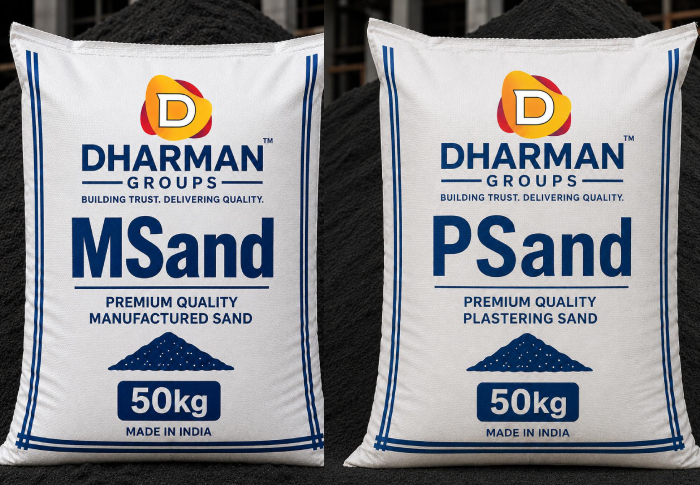
Our M-Sand and P-Sand manufacturing plant is a modern industrial facility dedicated to producing high-quality manufactured sand for construction and plastering applications. M-Sand (Manufactured Sand) is a superior alternative to natural river sand used in concrete, while P-Sand (Plastering Sand) is specially processed for plastering, masonry, and finishing works that require a finer, smoother texture.
The plant utilises advanced crushing, screening, washing, and grading technologies to convert hard rock into precisely sized sand particles that meet stringent construction standards. Through controlled production processes and rigorous quality checks, the manufactured sand ensures uniform particle size, improved strength, better workability, and reduced impurities compared to conventional sand sources.
Environmentally responsible operations are a key advantage of M-Sand and P-Sand plants, as they reduce dependence on river sand mining and promote sustainable use of natural resources. Modern plants are designed for high efficiency, minimal waste generation, and consistent output to support the growing demands of residential, commercial, and infrastructure projects.
By delivering reliable, eco-friendly, and high-performance sand solutions, an M-Sand and P-Sand manufacturing plant plays a vital role in building durable, safe, and sustainable structures for the future.
“Engineered Sand for Stronger Construction”
Key Advantages
- Superior strength and workability due to angular particles that bond better in concrete mixes.
- Cost-effective (45-50% cheaper than river sand) with zero wastage and uniform quality per IS 383 standards.
- Sustainable option, reducing riverbed mining impacts while available near project sites
M Sand vs river sand differences
M-Sand (Manufactured Sand) and river sand differ mainly in shape, quality consistency, and environmental impact, with M-Sand often preferred for structural concrete due to its superior bonding.
Key Differences
| Aspect | M-Sand | River Sand |
| Shape | Angular and rough | Round and smooth |
| Consistency | Uniform grading | Variable quality |
| Impurities | Minimal after washing | Often contains silt/clay |
| Strength | Higher compressive strength | Lower, depends on source |
| Cost/Availability | Abundant, cost-effective | Depleting, pricier |
| Eco-Impact | Sustainable, no river mining | Harms river ecosystems |
Environmental impact of using M Sand
Best practices for using M Sand in construction
Which is better for concrete vs plastering
M-Sand is better for concrete due to its angular particles that provide superior interlocking and higher compressive strength.
Concrete Applications
M-Sand enhances load-bearing mixes with consistent grading and minimal impurities, reducing water demand after proper washing. River sand’s round grains weaken bonds in structural pours
Construction Cost Impact
For a typical house, switching to M-Sand can save 20-40% on aggregate expenses due to lower per-ton rates and consistent supply, though river sand may add 10-20% extra cleaning costs.
Environmental impact costs of using river sand
Environmental impact costs of using river sand
River sand mining imposes significant environmental costs, including ecosystem degradation, increased flood risks, and economic losses estimated in billions annually worldwide, with India facing acute impacts from habitat loss and groundwater depletion.
Ecological Impacts
Excessive extraction erodes riverbanks, deepens beds, destroys aquatic habitats, and disrupts food webs, leading to biodiversity loss and fishery collapses. It also lowers groundwater tables and allows saltwater intrusion in deltas.
M-Sand, or Manufactured Sand, is a crushed fine aggregate produced from hard rocks like granite, serving as an eco-friendly substitute for depleting river sand in construction.
PSAND
P-Sand, or Plastering Sand, is a finely crushed aggregate material specifically processed for plastering and masonry applications in construction.
Key Properties
It features ultra-fine particles (typically 0.15–2.36 mm), ensuring smooth finishes, low shrinkage, and strong bonding with cement. This makes it superior to coarser sands for wall and ceiling plastering.
Common Uses
- Interior and exterior plastering for even surfaces.
- Masonry work requiring high workability and minimal cracks.